Skip to content
Irvine, CA, 92618

Business hours

Express Analytics - Advanced Database Management Company

Monday
8:30am-5pm
Tuesday
8:30am-5pm
Wednesday
8:30am-5pm
Thursday
8:30am-5pm
Friday
8:30am-5pm
Saturday
Not provided
Sunday
Not provided

You can anytime during the day with your query.

(949)466-8450

Latest Posts & Updates

Fresh stories, announcements and offers about Database Management Company, Business management consultant, Business to business service, straight from our business.

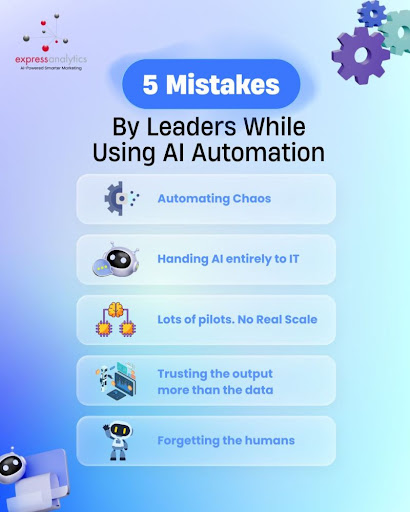
AI automation isn’t failing because the tech doesn’t work.

It’s failing because of how leaders are using it. Almost every leader we speak to is exploring AI automation. And almost every one of them is quietly frustrated. Not because the tools don’t work, but because things don’t move the way they expected. Across conversations with CIOs and business leaders, we keep seeing the same mistakes repeat: • Automating chaos - If a process is already confusing, AI just helps you run in circles faster. • Handing AI entirely to IT - Automation changes how teams work, not just systems. When business teams aren’t involved, adoption stalls. • Lots of pilots. No real scale. - A chatbot here. A workflow there. But no clear idea of what actually changes once AI is “live.” • Trusting the output more than the data - AI can sound confident even when the data underneath is messy. That’s where mistakes creep in. • Forgetting the humans - People worry about losing control, relevance, or clarity and no tool fixes that on its own.

AI automation isn’t failing because the tech doesn’t work. post imageRead full post

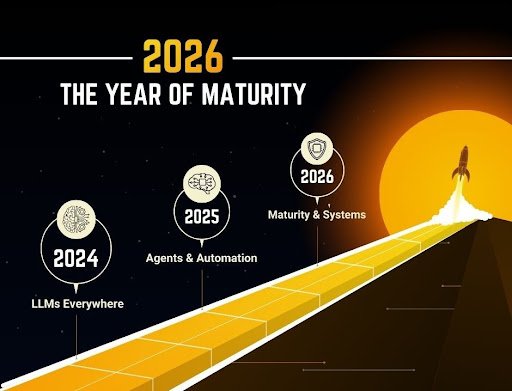
Over the last two years, AI moved fast.

2024 was about LLMs everywhere. 2025 became the year of agents and automation. But as I look toward 2026, I don’t see another “AI explosion.” I see something more important: maturity. The conversations I’m having with enterprise leaders are changing. They’re no longer asking “What model should we use?” They’re asking “What actually works for our business?” And that shift is quietly breaking a few assumptions we’ve all carried. For example - ⇨ Bigger models won’t automatically win. Smaller, specialized models trained on the right data are already outperforming giants in real workflows. ⇨ Hallucinations aren’t a reason to wait. They’re reasons to design better systems; RAG, monitoring, human-in-the-loop, and model checks. ⇨ Cloud-only isn’t mandatory. On-prem and hybrid AI are becoming practical again, especially with regulation tightening. ⇨ Agent swarms sound exciting, but in 2026, deep, reliable single agents will deliver more value than fragile orchestration experiments.

Over the last two years, AI moved fast. post imageRead full post

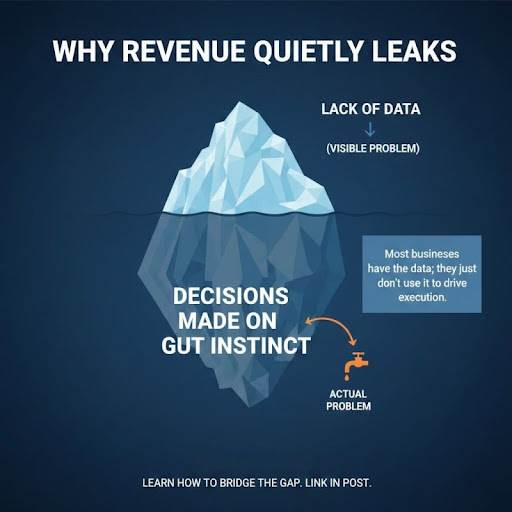
Most businesses don’t struggle because they lack data.

They struggle because decisions still get made on instinct. “We think this campaign is working.” “This feels like the right market.” “Let’s try it and see.” And that’s exactly where revenue quietly leaks. The companies growing faster today are simply making better decisions. In our latest blog, we break down how data-driven decision making actually increases business revenue, not in theory, but in day-to-day execution: • Where data really changes outcomes (and where it doesn’t) • How teams move from reports → real decisions • Why revenue grows when data is shared, not fragmented • What separates “data-aware” companies from data-driven ones

Most businesses don’t struggle because they lack data. post imageRead full post

Agentic commerce isn’t something I’m watching anymore.

It’s something I’m actively thinking around as a leader. I was going through McKinsey’s latest work on agentic commerce, and one line stayed with me long after I closed the report: In the next wave of commerce, your primary customer may not be a human. It may be their AI agent. That’s a quiet sentence. But it carries a massive shift. For years, we’ve trained ourselves to fight for - ⇨ clicks ⇨ impressions ⇨ page visits Now the question is changing. What happens when the “decision-maker” isn’t scrolling a page, but evaluating your brand machine to machine? Suddenly, the competition isn’t just about visibility. It’s about algorithmic trust. Can an AI agent - ⇨ understand your product and pricing without ambiguity? ⇨ validate inventory and policies in real time? ⇨ trust your systems enough to transact without a human pause? McKinsey estimates agentic commerce could orchestrate $3–$5 trillion in global retail value by 2030. That’s not a new channel. That’s a new decision layer sitting between people and the market. Here’s where my own thinking has shifted - • From “SEO for humans” → to agent-readable, API-first discovery • From optimizing landing pages → to designing agent experiences • From marketing to people → to earning the confidence of the agents that filter choices Are you already seeing early signs of “agentic traffic”? What does being agent-compatible mean on your roadmap today?

Agentic commerce isn’t something I’m watching anymore. post imageRead full post

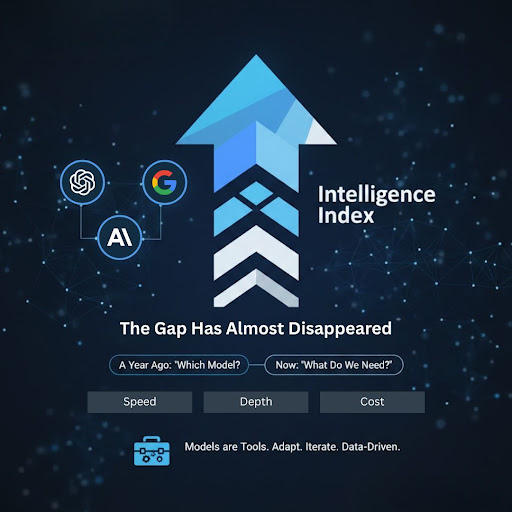
Just went through the latest Intelligence Index from Artificial Analysis and honestly…

…this is one of those “pause and rethink” moments. The gap at the top has almost disappeared. OpenAI, Anthropic, Google, they’re all trading blows now. Agents, coding, reasoning, no clear runaway leader anymore. And as someone building with these models every day, this feels like a shift. A year ago, the question was “Which model should we back?” Now it’s more like “What do we need this model to do, right now?” Speed matters in one place. Depth matters in another. Cost suddenly matters a lot when you’re scaling. As someone building in this space daily, it feels like a real turning point. Forget picking a winner, now it's about figuring out which model (or combo) actually works best for your specific needs - speed for customer service, depth for analysis, cost for scale. I've been testing this myself across a few projects, and yeah, the right mix beats any single "best" model every time. The smart play? Build like models are just tools in the toolbox, swap 'em as they evolve, ground everything in solid data, and keep iterating based on what actually moves the needle. This benchmark drop just made that future feel a lot more real. That’s changed how I think about AI systems altogether. The real advantage comes from how flexible your stack is, how clean your data is, and how fast you can adapt as things evolve (which, clearly, they are).


Just went through the latest Intelligence Index from Artificial Analysis and honestly…  post imageRead full post

Excited to announce that Express Analytics is a proud sponsor of the Digital Enterprise CIO Trans…

Excited to announce that Express Analytics is a proud sponsor of the Digital Enterprise CIO Transformation Assembly 2026. We can’t wait to connect with visionary CIOs and technology leaders shaping the future of business. If you’re attending, come say hello! We’ll be showcasing how our AI-driven and advanced analytics solutions are helping enterprises turn complex data into clear, actionable strategies for growth and customer loyalty. Let’s discuss the future of data-driven leadership. See you in Miami!

Excited to announce that Express Analytics is a proud sponsor of the Digital Enterprise CIO Trans… post imageRead full post

How do businesses really use data, analytics, and AI to deliver true business value?

Organizations with AI-ready data report a 26% boost in outcomes. But 65% don’t have AI-ready data or don’t even know if they do. And Gartner warns, by 2026, 60% of AI projects will fail unless companies build AI-ready data practices. The question isn’t “Do we have AI?” anymore. It’s “Do we have data that’s ready for AI?” Because AI without the right data is like putting rocket fuel in a car engine, it won’t take you where you want to go. Proving AI readiness starts with - ⇨ Aligning data to the business use ⇨ Qualifying how that data can actually be used ⇨ Governing it contextually to keep it reliable At Express Analytics, we help businesses transform raw data into AI-ready data that drives real ROI, not just dashboards. What’s the biggest roadblock you see in making data AI-ready; organizational structures, governance, or mindset?

How do businesses really use data, analytics, and AI to deliver true business value? post imageRead full post